Address
Visit or write to us
Tobias Andermann
Evolutionary Biology Centre (EBC)
Norbyvägen 18D
752 36 Uppsala
Sweden
Collaborations and visits
We are always interested in new perspectives and fresh ideas coming into the lab.
Opportunities
We are always happy to host students for a degree project. Below are a few ideas, but if you have your own topic or are generally interested in our work, just contact us.
Metabarcoding paired with environmental DNA is changing the way we survey biodiversity in the field. By collecting samples from soil, water, dead wood, or spider webs, we can sequence the DNA found within these samples to obtain a list of organisms that exist at a site.
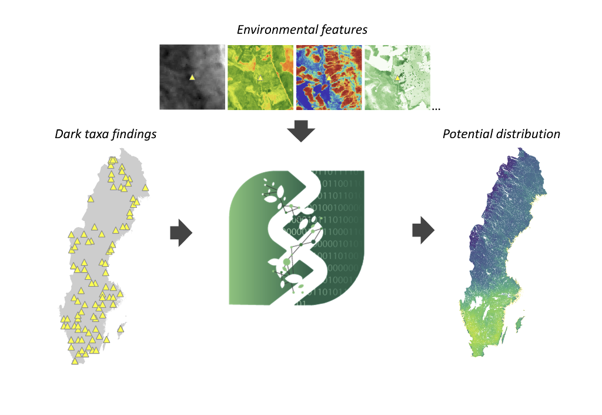
For many biodiversity surveys that use eDNA and metabarcoding, many sequences do not match the reference databases. Many of these sequences are unknown to science, often referred to as dark taxa, and in order to gain more knowledge about them, we need to know where they exist.
In this master project, the aim is to find these undescribed taxa and to map their potential spatial distributions through spatial distribution modeling (SDM) methods. By searching for correlations between the sample sites where the taxa are found with several environmental features, such as elevation, temperature, different vegetation indices with SDMs to gain insights into where these organisms might exist. As a result, we can target in-field sampling to these areas in order to allow scientists to further explore these unknown taxa. The student will gain hands-on experience across the full workflow, from bioinformatic processing of metabarcoding data to building and interpreting species distribution models in R or Python.
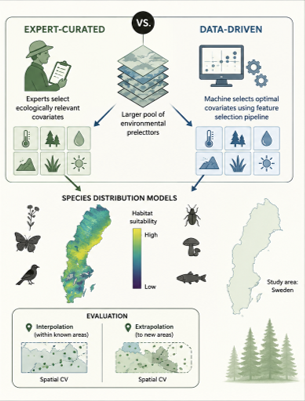
Which environmental covariates make the best species distribution models: those chosen by ecological experts, or those selected by data-driven algorithms? This master's project will compare expert-curated and automated feature-selection approaches for predicting habitat suitability of Swedish species.
Working with a small set of species from different taxonomic groups, the student will build species distribution models using two equally sized covariate sets: one selected by experts and one derived by a feature-selection pipeline from the same pool of candidate predictors. Model performance will be evaluated in terms of model error and uncertainty, in both interpolation and extrapolation scenarios.
The work will leverage data and modelling pipelines developed by the Biodiversity Data Lab, allowing the student to focus on the research questions at hand.
We are looking for a master student in biology, statistics, or machine learning. Basic programming experience in R or Python and introductory statistics is required. More advanced courses in ecology, statistics, and/or machine learning are a plus.
Address
Tobias Andermann
Evolutionary Biology Centre (EBC)
Norbyvägen 18D
752 36 Uppsala
Sweden
Donate
With your donation, you directly contribute to biodiversity data and computational models that help combat the global biodiversity crisis.
This funding package would provide all necessary consumables and processing costs, including DNA sequencing, for 1,000 eDNA sampling kits. This will provide essential training data for our biodiversity models.
This package would provide salary, social fees, and overhead for employing a 50% full-time laboratory assistant for sample processing, DNA extraction, and preparation for sequencing.
Purchasing our own bench-top DNA sequencing machine would decrease costs per eDNA sample and speed up biodiversity data generation. Options in this range include the PacBio Vega Benchtop System or Nanopore PromethION sequencer.
A full-time biodiversity data engineer would help make research outputs accessible via online portals and user-friendly map services for decision-makers, researchers, businesses, and the public.